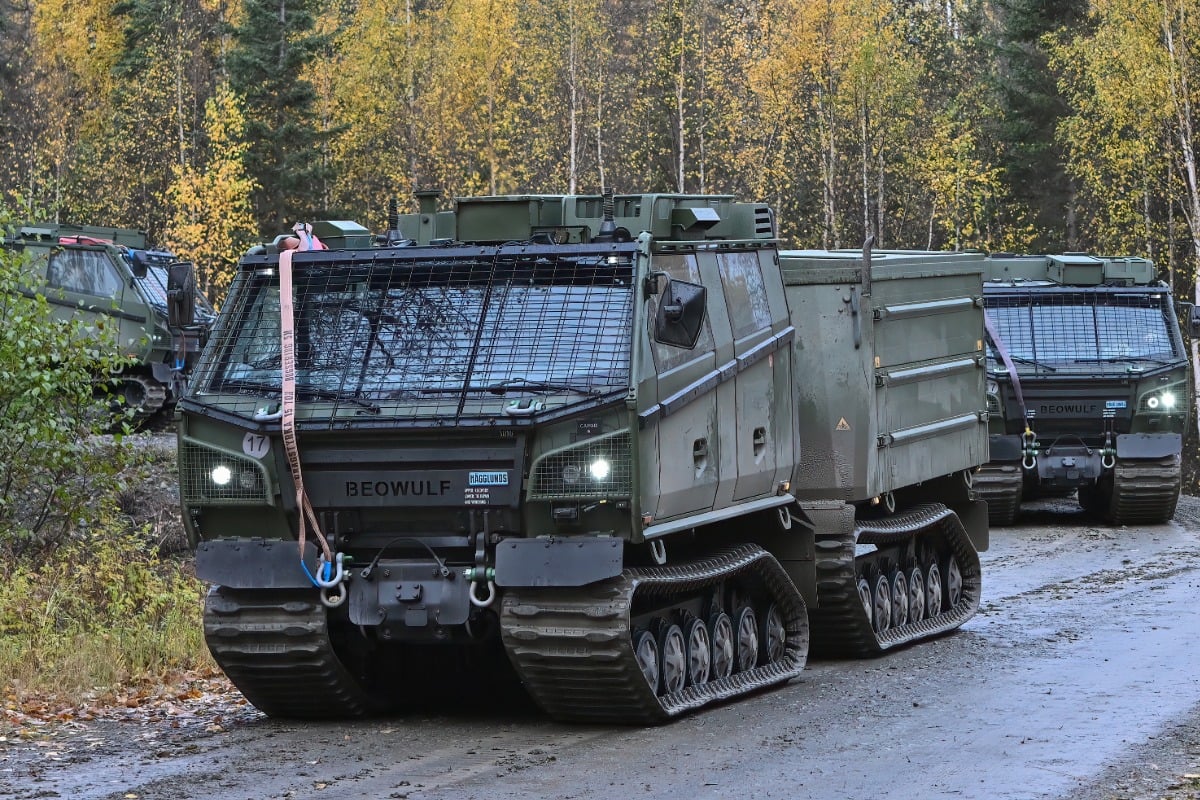
The Pentagon just spent another $35 million on a tracked box that swims, climbs mountains, and doesn't freeze when the thermometer hits minus fifty.
On June 30, 2026, the U.S. Army awarded BAE Systems Land and Armaments a contract modification to build more Cold Weather All-Terrain Vehicles. You might know it as the Beowulf. It looks unusual. It has a articulated two-cabin design and looks more like heavy construction equipment than a sleek weapon of war. But the military is betting big on it.
The defense community often ignores cold-weather operations. Everyone focuses on Pacific island-hopping or desert warfare. That is a massive mistake. The Arctic is warming, shipping lanes are opening, and Russia is aggressively building military bases across its northern coast. If you think the next conflict won't involve deep snow and frozen tundra, you aren't paying attention. The Army needs a machine that can actually move in these conditions. Tanks sink into spring mud. Standard trucks freeze their fluids and get stuck instantly. The Beowulf is the fix.
The Reality of Fighting in Minus Fifty Degrees
Operating in extreme cold changes everything. Metal becomes brittle. Batteries lose half their charge in minutes. Rubber tracks snap like stale crackers. If a vehicle breaks down in the Alaskan interior, it isn't just an inconvenience. It's an immediate threat to the lives of the soldiers inside.
The Army relies heavily on the 11th Airborne Division based in Alaska. They call themselves the Arctic Angels. For decades, their ability to move across the frozen north was severely limited. They lacked modern specialized mobility. Infantry units can't walk through waist-deep snow for miles and expect to fight effectively at the end of the march. They arrive exhausted, frozen, and useless.
The Beowulf solves this exact problem by ignoring traditional wheels. It uses two separate compartments connected by a hydraulic steering joint. The design spreads the weight of the vehicle across a massive surface area. Because of this, the ground pressure it exerts is incredibly low. It can drive over deep snowdrifts, deep mud, and treacherous swampland without sinking.
Consider the spring thaw. Soldiers call it the mud season or muskeg. It destroys normal military logistics. The ground turns into a soup of decaying vegetation and water. Heavy tracked vehicles like the M1 Abrams tank or Bradley fighting vehicle will simply bottom out and get stuck. The Beowulf floats right over it. It doesn't pack a giant cannon, but it gets troops to the objective alive and dry.
Replacing a Forty Year Old Relic
To understand why this $35 million contract modification matters, you have to look at what the Army was using before. The legacy platform was the Small Unit Support Vehicle. It was designated as the BV206. It came into service during the early 1980s.
It was a great machine for its time. But it grew old. Mechanics couldn't find spare parts anymore. The manufacturing lines shut down years ago. Trying to fix a broken suspension component in a 1983-built vehicle during a blizzard is a nightmare. The electronics were ancient. The engine lacked power. The interior was cramped and lacked modern climate controls.
The Army realized it was spending millions just to keep a handful of these relics running. In 2019, the Requirements Oversight Council officially declared the old vehicles unsustainable. They launched the competition for a replacement.
BAE Systems went head-to-head with a team from Oshkosh Defense and ST Engineering. Oshkosh brought a vehicle based on the Bronco platform. BAE brought the Beowulf. After intense testing at the Cold Regions Test Center in Fort Greely, Alaska, the Army chose BAE. They initially signed a $278 million deal in 2022 to buy an initial batch of 110 vehicles. This new 2026 funding shows that the Army likes what it saw and wants to expand the fleet as fast as possible.
What Makes the Beowulf Tick
This isn't an armored combat vehicle. It doesn't have heavy steel plates or a missile launcher. The primary job is moving nine soldiers and their gear through hellish terrain.
Look at the raw numbers. The power comes from a modern commercial engine putting out 285 horsepower. That might not sound like a lot compared to a supercar, but it is mated to a highly efficient transmission designed for low-speed torque. It tops out at around 40 miles per hour on roads. That is plenty fast for an articulated tracked vehicle.
The fuel range is impressive. It can travel over 620 miles on a single fill-up. Logistical footprints matter out in the wild. If your vehicle drinks fuel like a jet, you spend all your time worrying about fuel trucks. The Beowulf runs efficiently, giving commanders a longer operational reach.
The interior is completely modular. You can change the layout in the field. One day it's a troop carrier. The next day you slide out the seats and install medical stretchers for casualty evacuation. It can also act as a mobile command post with radios and satellite links, or a simple cargo hauler with a 10,000-pound payload capacity.
It also swims. If it encounters a river or a flooded coastal zone, it doesn't need a bridge. The tracks act as paddles. It moves through water at about four kilometers per hour. No preparation required. You just drive straight into the water and keep going.
Air transportability was another major requirement. The Army can load the Beowulf into a C-130 transport plane. Even better, a CH-47 Chinook helicopter can carry it using a sling load. The vehicle can decouple into two halves if needed, making it easy to transport via air and drop directly into remote outposts.
Geopolitics on Thin Ice
Why are we buying these now? Look at the map. The Arctic contains massive untapped reserves of oil and natural gas. As the ice melts, new shipping lanes open up. These routes cut transit times between Asia and Europe significantly.
Russia has noticed. They have established a dedicated Arctic command. They have reopened dozens of Soviet-era military bases. They have icebreakers lined with cruise missiles. They routinely practice airborne drops in freezing conditions.
China also calls itself a near-Arctic nation. They want a piece of the trade routes. They are investing heavily in northern infrastructure.
The U.S. military fell behind. We spent twenty years fighting counterinsurgency missions in hot deserts. We let our cold-weather muscles atrophy. This purchase is part of the strategy to regain dominance in the north. We cannot deter adversaries if our vehicles freeze when they leave the garage.
The Army National Guard also needs these units. When a major winter storm hits the northern states, normal emergency vehicles can't move. The Guard uses these tracked vehicles for search and rescue operations. They save civilian lives during blizzards.
Moving Forward
If you want to track where this equipment goes next, keep your eyes on the northern training grounds. The initial deliveries went straight to the Northern Warfare Training Center at Fort Wainwright, Alaska. Soldiers there are rewriting the manual on cold-weather tactics.
The next step is integrating these newly funded vehicles into active-duty units and National Guard elements across Alaska, Vermont, and Minnesota. Watch for upcoming winter exercises like Arctic Edge. That is where we will see if this investment pays off. Look for reports on maintenance reliability and how the commercial parts hold up under brutal conditions.