Love her or loathe her, you couldn't ignore her. The passing of Ann Widdecombe at age 78 marks the end of a very specific, totally unapologetic era in British public life.
She wasn't designed for the era of focus groups and hyper-polished PR. She didn't care about being liked, which, ironically, is exactly why millions of people eventually fell in love with her on Saturday night television. She was an uncompromising right-winger, a devout Catholic convert, a fierce Eurosceptic, and an animal rights champion who spent her final years campaigning for Reform UK.
You don't see politicians like that anymore. Today's political landscape is full of people terrified of saying the wrong thing. Widdecombe? She leaned right into it.
The Iron Lady of the Home Office
Long before she was flying across the Strictly Come Dancing ballroom attached to a harness, Widdecombe was making senior men in the Conservative Party sweat. Elected as the MP for Maidstone in 1987, she quickly marked her territory on the Tory right.
Her career under John Major was defined by a stern, unyielding approach to justice. As prisons minister between 1995 and 1997, she famously defended the policy of chaining pregnant prisoners to their hospital beds during labor. It sparked massive outrage. Did she back down? Not a chance. She believed in rules, order, and punishment, and she didn't care if that made people uncomfortable.
But her most legendary political moment came in 1997, and it wasn't directed at the Labour opposition. It was a targeted strike against her own former boss, Michael Howard.
"There is something of the night about him."
With just eight words delivered on television, she effectively sabotaged Howard's bid for the Tory leadership at the time. It was brutal, memorable, and devastatingly effective. It showed a woman who operated entirely on her own terms, completely independent of party tribalism if she felt her principles—or her personal grudges—warranted it.
When the Pantomime Villain Became a National Treasure
By the time Widdecombe stepped down from Westminster in 2010, most of the public viewed her as a stern, out-of-touch moralist. She opposed abortion, voted consistently against LGBT rights, and fought the repeal of Section 28. To the modern, liberal Briton, she was the ultimate political pantomime villain.
Then came Strictly Come Dancing.
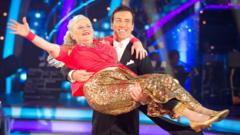
If you've never watched her 2010 run with professional dancer Anton Du Beke, it's hard to understate how culturally bizarre it was. She had zero rhythm. She looked like a human vacuum cleaner being dragged across the floor during their infamous paso doble. The judges, particularly Craig Revel Horwood, absolutely slaughtered her performance week after week.
But the public kept voting.
They didn't vote because she was good; they voted because she was completely in on the joke. She knew she couldn't dance, but she gave it everything anyway. It revealed an inner warmth and a sense of humor that decades in Westminster had obscured. Sir Iain Duncan Smith later noted that the show revealed a side of her that even her closest political colleagues had barely seen. She made it all the way to the semi-finals on pure force of personality.
The Farage Years and the Brexit Crusade
You might think a reality TV reinvention would lead to a quiet retirement of writing novels and doing pantomime gigs. For a while, it did. She was a runner-up on Celebrity Big Brother in 2018 and made regular appearances on late-night chat shows.
But politics was in her blood. The 2016 Brexit referendum pulled her right back into the arena. As an ardent, lifelong Eurosceptic, she threw her weight behind the Leave campaign.
When the political establishment stalled on delivering the exit deal, Nigel Farage came calling. In 2019, she made a dramatic return to frontline politics, standing for the newly formed Brexit Party. She was elected as an MEP for South West England, heading to Brussels not to govern, but to help dismantle Britain’s relationship with the EU from the inside.
Nigel Farage noted that her decision to join the party gave the entire movement a massive boost. The voters loved her because they knew exactly what they were getting. She wasn't a careerist looking for a promotion; she was a conviction politician finishing a job she started decades earlier. When the Brexit Party transitioned into Reform UK, she stayed on, serving as the party's immigration spokesperson right up until her death.
The Contradictions That Defined Her
What most people get wrong about Ann Widdecombe is trying to fit her into a neat ideological box.
Yes, she was deeply socially conservative. She converted from Anglicanism to Roman Catholicism in 1993 because she fundamentally disagreed with the ordination of female priests. Her views on same-sex dancing on Strictly or LGBT rights were frequently, and rightly, criticized for being wildly out of step with modern Britain.
Yet, this same hardline conservative was a passionate, tireless advocate for animal welfare. She fiercely opposed fox hunting, a stance that put her completely at odds with the traditional country Tory base. She spent her free time patronizing animal charities, proving that her moral compass, however eccentric, was entirely her own. She never married, openly stated she had no interest in sex, and lived a life completely dedicated to her faith, her causes, and her public duties.
She lived by a simple philosophy that she once shared on The Graham Norton Show:
"We get one go this side of eternity, one go. Life is not a dress rehearsal, you take opportunities that you like and you go for it."
What We Can Learn From the Widdecombe Era
You don't have to agree with a single policy Ann Widdecombe stood for to appreciate what her career represents. She belonged to a generation of politicians who built their reputations on conviction rather than focus groups.
If you want to understand how British politics lost its flavor, look at how we treat politicians today. We demand authenticity, but the moment a politician shows a genuine, unvarnished opinion that deviates from the script, the internet tears them apart. The result is a political class that feels entirely hollowed out.
Widdecombe was never hollow. She was solid, stubborn, and entirely authentic to her own worldview, for better or worse.
If you're looking for a way to cut through the noise in your own life or career, take a page out of her book. Stop trying to please everyone. Figure out what your core values are, state them clearly, and don't apologize for holding them. You might turn some people off, but you'll earn the respect of those who value real conviction over manufactured consensus.