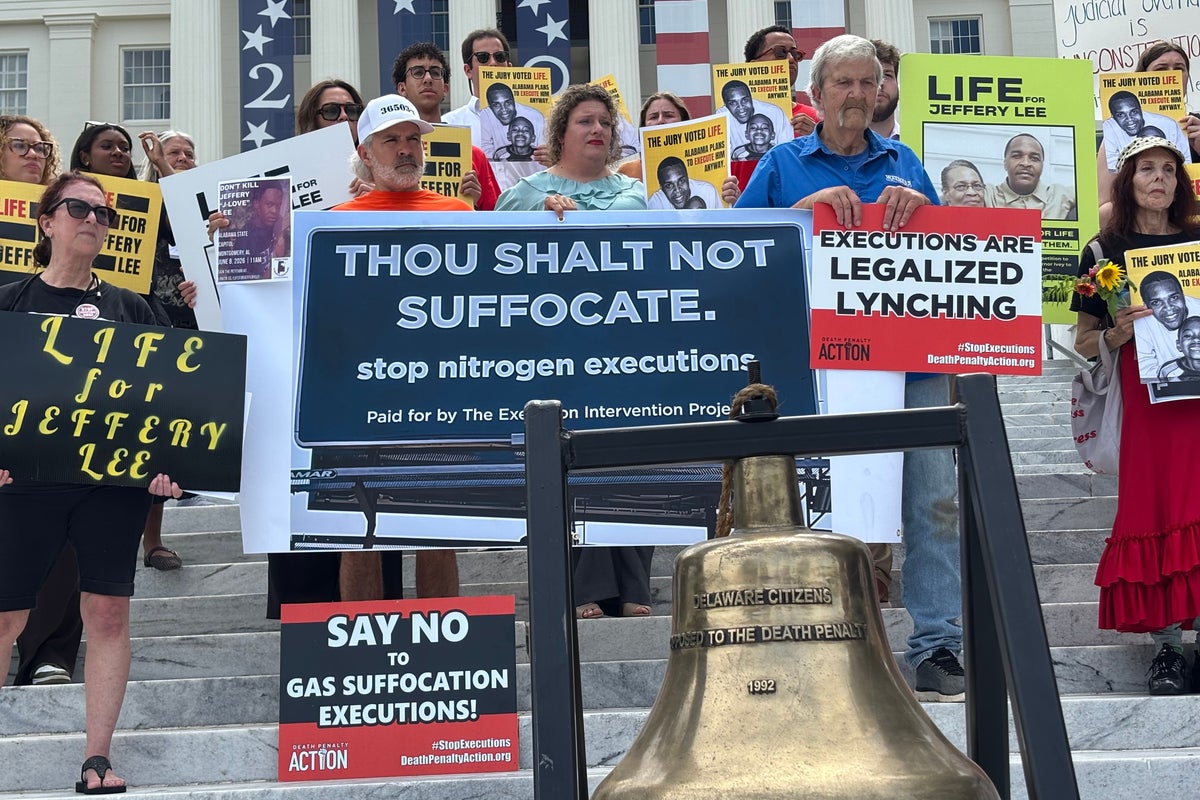
The death penalty landscape just hit a massive roadblock in Montgomery. In a dramatic legal pivot, U.S. District Judge Emily Marks permanently blocked Alabama from executing death row inmate Jeffery Lee using nitrogen gas. The sudden decision landed just 48 hours before Lee was scheduled to die on June 11, 2026.
This isn't just another routine stay of execution. It represents the first time a federal court officially branded America's newest execution method unconstitutionally cruel and unusual.
For months, Alabama officials insisted that breathing pure nitrogen through a heavy face respirator was a quick, humane way to die. Judge Marks initially agreed with them. In late May, she ruled that the protocol was completely constitutional.
But things changed fast. A three-judge panel from the 11th U.S. Circuit Court of Appeals stepped in and shattered that narrative, forcing Marks to reverse her stance. Now, Alabama's experimental execution machine is facing a major constitutional crisis.
Three Minutes of Conscious Suffocation
The core of the legal battle comes down to what actually happens when the state flips the switch. Alabama has already used nitrogen hypoxia to execute seven people since early 2024, with Louisiana using it once. State lawyers routinely argue that the process causes a quick loss of consciousness.
The appeals court looked at the actual evidence and reached a far darker conclusion.
According to court filings, the state's nitrogen protocol causes severe "air hunger" — the most extreme form of breathing discomfort and panic a human can experience. The 11th Circuit noted that it takes up to three minutes for an inmate to lose consciousness under the mask. They explicitly labeled that three-minute window of conscious suffocation an "intolerable" timeframe.
The appellate judges stated that Alabama's protocol carries a substantial risk of serious harm, meaning severe pain over and above death itself. When forced to apply that logic, Judge Marks wrote in her 26-page ruling that Lee had proven by a preponderance of the evidence that the protocol violates the Eighth Amendment.
Witnesses to past nitrogen executions in Alabama have reported inmates shaking violently and straining against their gurney straps for minutes. While the state claimed those movements were just involuntary muscle spasms, medical experts and defense attorneys argued they were signs of agonizing suffocation.
The Alternative Nobody Wants to Talk About
To challenge an execution method under current federal law, death row inmates face a bizarre requirement. They can't just argue that a method is cruel. They have to suggest a viable alternative.
Jeffery Lee's legal team suggested a firing squad.
In her ruling, Judge Marks acknowledged the irony. She noted that if Alabama actually adopted the firing squad, that method would face immediate legal challenges too. She wrote that there is likely no method, no matter how humane, that would be immune to constitutional challenges.
It's a sobering reality. The Constitution doesn't guarantee a painless death. Human life can't be purposefully ended without some risk of pain. But three minutes of gasping for oxygen crossed the line from necessary execution to unconstitutional torture in the eyes of the court.
Crucially, Marks didn't say Alabama can't execute Lee at all. She only banned them from using nitrogen gas. The state still has lethal injection and the electric chair on the books. Lee remains at the Holman Correctional Facility in Atmore while the state figures out what to do next.
The Jury Explicitly Voted to Spare His Life
Lee's case carries a deep layer of controversy that stretches back long before nitrogen masks were ever invented. In 2000, a jury convicted him of capital murder for the 1998 shooting deaths of Jimmy Ellis and Elaine Thompson during a pawnshop robbery in Orrville, Alabama.
When it came to sentencing, the jury voted 7 to 5 to give Lee life in prison without the possibility of parole. They didn't want him executed.
But back then, Alabama law gave trial judges a controversial power known as "judicial override." The trial judge simply ignored the jury's 7-5 vote and sentenced Lee to death anyway.
Alabama finally abolished judicial override in 2017 because critics argued it was fundamentally undemocratic. If Lee were tried today, he wouldn't be on death row. The state refused to make that law retroactive, leaving over two dozen men on death row whose juries chose life, not death.
Lee's defense lawyers also dropped the ball during his original trial. They failed to present vital mitigating evidence to the jury. Lee suffered a severe traumatic brain injury in a car accident as a youth. He experienced brutal childhood abuse and suffered from untreated mental illness and substance addiction that started when he was just eight years old.
Even without knowing that history, the majority of the jury still wanted to spare his life. During his decades behind bars, Lee turned his life around, serving as an assistant chaplain and a ministry leader for other inmates.
What Happens Next
Don't expect Alabama to back down quietly. Attorney General Steve Marshall's office immediately filed an appeal on Tuesday night. State officials have heavily championed nitrogen gas as the future of capital punishment, especially as lethal injection drugs become harder to source from pharmaceutical companies.
This case is on a direct collision course with the U.S. Supreme Court. The highest court in the land has never ruled a state's chosen method of execution unconstitutional. Up until now, conservative justices have consistently cleared the path for Alabama's nitrogen executions to proceed.
For now, the state's nitrogen protocol is frozen. Legal teams across the country are watching this case closely. If the 11th Circuit's logic holds up under Supreme Court scrutiny, it could mean the total collapse of nitrogen executions nationwide.
If you are tracking capital punishment policy or constitutional law, keep your eyes on the federal docket over the next few weeks. The state will push for an expedited review to get Lee's execution back on track, while defense teams will use this historic ruling to challenge nitrogen protocols in every other state that currently authorizes them.