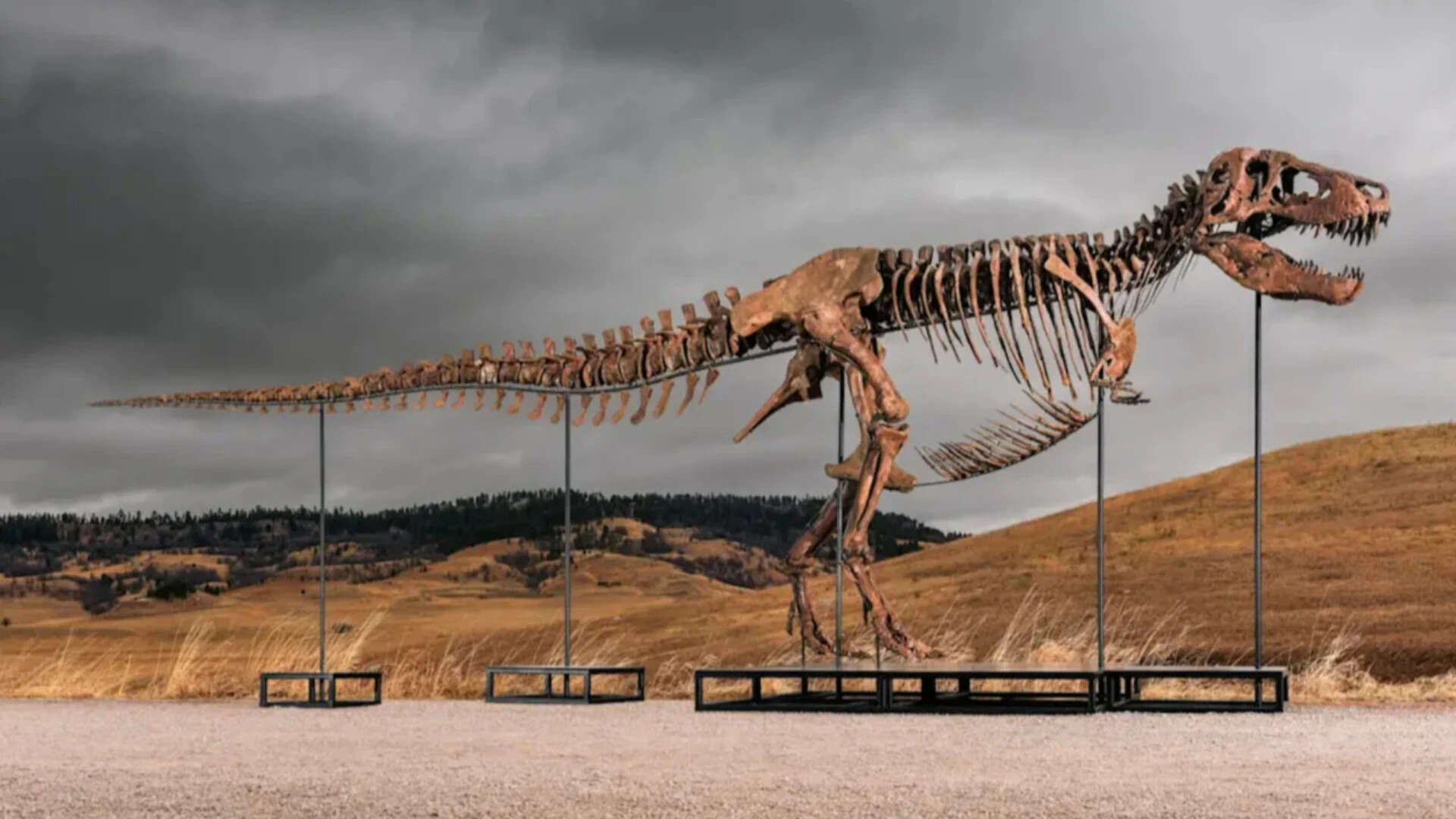
A massive Tyrannosaurus rex skeleton is heading to the auction block this July, and it carries a jaw-dropping price tag of up to $30 million. The fossil is nicknamed Gus. It is 38 feet of prime prehistoric apex predator, dug out of the dirt in South Dakota. While auction houses celebrate these multi-million-dollar sales as historic milestones, the scientific community views them with genuine dread. We are watching the history of our planet turn into a playground for billionaires.
When Sotheby's puts Gus under the hammer in New York on July 14, it will not just be a transaction. It represents a massive shift in how we value natural history. For decades, major fossil discoveries went straight to public museums. Scientists studied them. Kids stared at them in awe. Today, these ancient bones end up in the private penthouses of tech moguls and hedge fund managers. If you have $30 million burning a hole in your pocket, you can buy a T. rex to stand next to your grand piano.
This trend is bad for science. It encourages a gold rush mentality that treats irreplaceable specimens like fine art or luxury real estate. When a fossil enters a private collection, it is effectively dead to researchers. Let's look at what makes Gus so valuable, how he was found, and why the surging market for dinosaur bones is actively harming our understanding of the prehistoric world.
The Cowboy and the Tyrant
Gus did not start out as a multi-million-dollar commodity. For millions of years, he was just part of the rock layers beneath a sprawling 6,500-acre cattle ranch in Harding County, South Dakota. The late Gary "Gus" Licking owned that land. He was an ordinary rancher with a sharp eye and a deep love for his property. Over many years, Licking kept finding small fossil fragments scattered across his ranch. He found teeth. He found bits of eroded bone.
Most people would have shrugged it off or kept them in a jar on the porch. Licking suspected something much larger was waiting underground. He believed those scattered pieces were a trail leading to a giant.
He was right. In 2021, Licking teamed up with a commercial paleontology company called Theropoda Expeditions. They brought in heavy equipment and expert eyes. They began digging in the exact spot Licking suggested. What they uncovered was staggering. Over three brutal summers, workers chipped away at the stubborn matrix of rock and clay. They battled the scorching South Dakota heat. They spent weeks digging through a complex fossil bed, sometimes finding absolutely nothing for days on end.
Sadly, Gary Licking died about a year after the excavation started. He never got to see the dinosaur fully assembled. The team named the specimen Gus to honor his memory and his decades of careful observation on the ranch.
Reassembling the World's Hardest Puzzle
Digging bones out of the ground is only the first step. The real work happens in the lab. It took another two years of meticulous work to clean, stabilize, and identify every piece of Gus. Commercial paleontologists use dental picks, tiny jackhammers called air scribes, and chemical stabilizers to separate rock from bone without causing damage.
Thomas Heitkamp, the president of Theropoda Expeditions, compared the process to tackling the world's hardest puzzle. The twist is that you have to find all the pieces first. You are working with an animal that has been dead for 67 million years. The earth shifts. Water moves things around. Scavengers tear carcasses apart before they fossilize.
The final result of this labor is an incredibly impressive skeleton.
- Length: 38 feet from snout to tail.
- Height: Nearly 12.5 feet tall at the hips.
- Bone Count: 183 fossilized bones.
- Completeness: Roughly 63% complete by bone count, making it one of the most complete T. rex specimens ever offered to the public.
Gus features a beautifully preserved skull that is over four feet long. He also has a intact pelvis and a rare furcula, which is the dinosaur's wishbone. Finding a wishbone is incredibly rare because those bones are delicate and easily destroyed during fossilization. The site where Gus was discovered also yielded fossilized plants and smaller animals from the Late Cretaceous ecosystem, offering a vivid snapshot of the environment where this predator ruled.
The Problem with Private Millions
Sotheby's has set the opening bid for Gus at $19 million. They expect the final price to land somewhere between $20 million and $30 million. Cassandra Hatton, the global head of science and natural history at Sotheby's, points to the exceptional preservation and completeness as the driving factors behind the massive valuation.
But this price tag creates a huge barrier. Public museums simply cannot compete at this level.
Most institutional paleontology departments operate on shoestring budgets. They rely on grants, university funding, and modest donations. When a single skeleton costs $30 million, a museum cannot just write a check. Even wealthy institutions cannot justify spending their entire acquisition budget on a single specimen, no matter how spectacular it is.
This means the buying pool for top-tier fossils has shifted completely to ultra-wealthy private individuals.
We saw this happen in 2020 when a T. rex named Stan sold for a record-breaking $31.8 million at Christie's. For a long time, the identity of the buyer remained a total mystery, causing widespread panic among paleontologists who feared Stan would vanish forever. It later emerged that the specimen was purchased for a new museum being built in Abu Dhabi. While that means Stan will eventually be on public view, it was a lucky break. Many other fossils vanish into private hands, never to be seen again.
Just two years ago, Sotheby's sold a Stegosaurus skeleton named Apex for a mind-boggling $44 million. That is the current record for any dinosaur fossil sold at auction. The buyer was billionaire hedge fund manager Ken Griffin. To his credit, Griffin loaned the fossil to a public institution, but relying on the charity of billionaires is a terrible way to run a scientific discipline.
Why Science Needs the Original Bones
A common counterargument from auction proponents is that we already have several T. rex skeletons in museums. Why do we need another one?
This argument misses the point of evolutionary biology. No two organisms are exactly alike. To understand a species, you cannot just look at one or two examples. You need a wide sample size.
Imagine trying to understand the entire human race by examining only five people. You would miss variations in height, health, bone density, and age. The same rule applies to dinosaurs. Every new T. rex skeleton provides critical data points. Scientists can examine the bones to determine how old the animal was when it died, whether it suffered from diseases, how it moved, and how it interacted with its environment.
The Flaw of Replicas
Some collectors offer to let scientists make plaster casts or 3D scans of their fossils before they take them home. While that sounds like a fair compromise, it is fundamentally flawed.
Technology changes. A 3D scan made today captures the surface details based on current imaging capabilities. Ten years from now, a researcher might develop a new technique to look inside the bone structure using advanced scanning methods that do not exist yet. If the original bone is locked away in a private mansion, that future research is impossible.
Furthermore, you cannot perform histological analysis on a plastic replica. Scientists frequently slice thin sections of fossilized bone to look at them under a microscope. This allows them to count growth rings, much like counting the rings of a tree, to figure out how fast the dinosaur grew. You need the actual fossilized tissue for that.
The Lack of Peer Review
Science depends entirely on verification. When a scientist publishes a paper about a discovery, other researchers must be able to examine the same evidence to see if the conclusions hold up. If a fossil is privately owned, the owner can revoke access at any time. If other scientists cannot verify the findings, the research becomes functionally useless. It cannot be peer-reviewed, which means it cannot be officially accepted into the scientific record.
The Complicated World of Commercial Digging
This issue is not entirely black and white. Commercial paleontology companies like Theropoda Expeditions do incredibly professional work. They employ trained experts who use proper scientific techniques to document dig sites. They create detailed quarry maps, log collection data, and preserve the surrounding matrix.
Without these commercial outfits, many fossils would simply rot away.
In the United States, fossil laws depend entirely on who owns the land. If a fossil is found on federal public land, it belongs to the government and can only be collected by permitted scientists. These fossils must go into recognized museum repositories.
However, if a fossil is found on private land, it belongs entirely to the landowner. They can do whatever they want with it. They can bulldoze it, let it erode into dust, or sell it to the highest bidder.
Landowners like Gary Licking own properties that are massive and expensive to maintain. When a commercial company offers to pay them a percentage of a multi-million-dollar sale, it is an offer that is almost impossible to refuse. It can save a family ranch from bankruptcy. This creates a powerful incentive for landowners to lock out academic paleontologists, who cannot offer payouts, and open their gates exclusively to commercial diggers.
This system is unique to America. Countries like Canada, Brazil, and Mongolia view fossils as national heritage items. In Alberta, Canada, any significant fossil found on private or public land belongs to the province. You cannot sell it overseas, and you cannot put it up for private auction. This keeps the focus entirely on education and scientific preservation.
What Needs to Happen Next
The impending sale of Gus shows that the luxury market for fossils is not slowing down. It is accelerating. If we want to save natural history from becoming nothing more than corporate decor, we need a change in approach.
First, wealthy philanthropists who want to support science should stop bidding against museums and start funding them instead. If a billionaire wants to spend $30 million on a T. rex, they should donate that money directly to an institution like the Field Museum or the American Museum of Natural History, allowing the museum to acquire the specimen openly. This ensures the fossil remains in the public trust while giving the donor immense prestige.
Second, we need to foster better partnerships between commercial diggers and academic institutions. Commercial teams are excellent at finding and extracting bones. Academic teams are excellent at analyzing and publishing data. If commercial outfits can negotiate pre-sale agreements with consortiums of museums or public donors before the hype of an auction house takes over, we can keep prices reasonable and keep the science intact.
Finally, you can vote with your feet. Support your local museums and science centers. Go see the fossils that are on public display. The more the public values these institutions, the more leverage they have to secure corporate sponsorships and government grants to protect future discoveries. Gus will likely fetch a fortune on July 14, but the true value of a dinosaur is found in what it teaches us about our past, not what it adds to a billionaire's net worth.