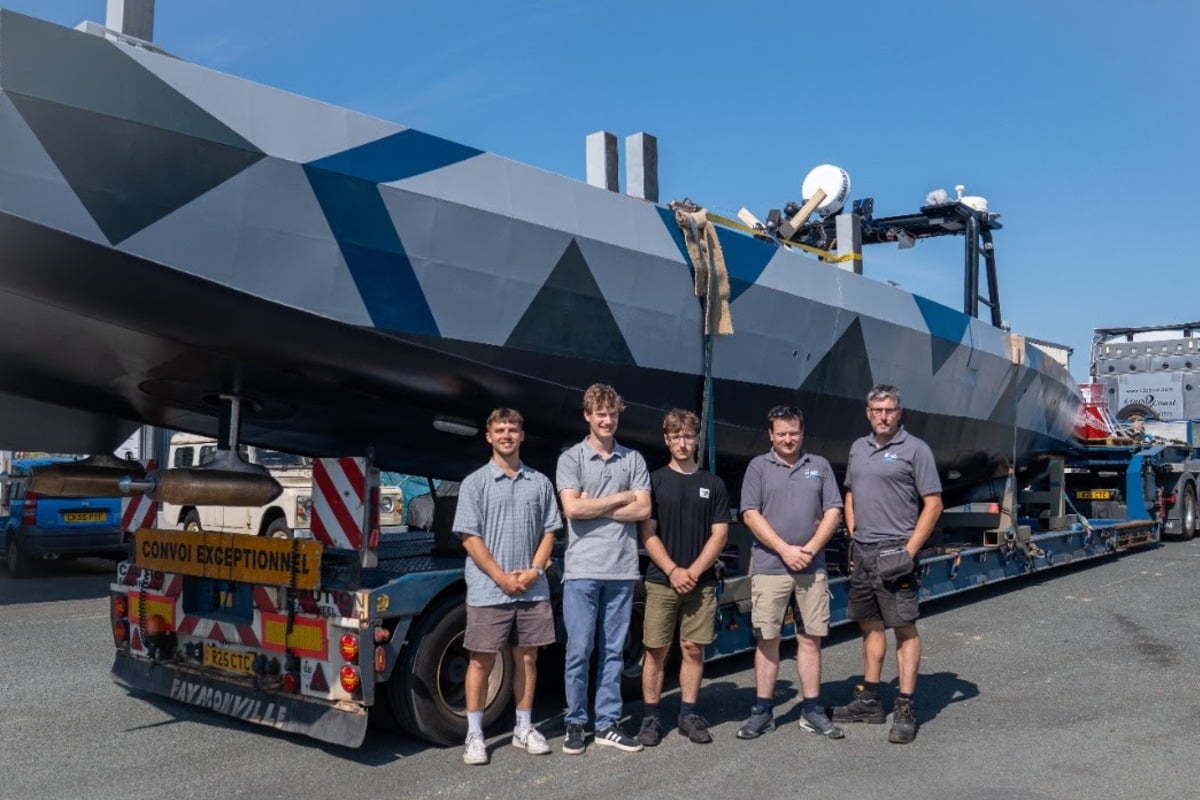
You do not need a crew of thirty sailors to patrol a shipping lane or monitor a deep-water wind farm anymore. In fact, a British marine company called ZeroUSV is proving you do not even need one person on board. The company has designed and started building the Oceanus17, a 17-meter robotic ship designed to stay at sea alone for up to two months.
People often think of drone boats as small, fragile rafts with a camera slapped on top. The Oceanus17 destroys that assumption. This is a massive, heavy-duty aluminum monohull built to withstand the brutal environment of the open sea. It handles everything from subsea inspection to military reconnaissance without complaining, getting tired, or needing a sandwich break.
This is not a concept drawing or a paper exercise. This is a real, physical vessel currently being built at the Manor Marine shipyard in Portland, Dorset. It represents a shift in how countries and private corporations think about maritime security, offshore energy, and ocean science.
What makes a robotic ship actually work
Building an autonomous boat is easy if you only want it to run for three hours in a calm lake. Doing it for two months in the North Atlantic is a completely different story. The secret to the endurance of the Oceanus17 lies in its hybrid diesel-electric drivetrain. It does not rely on a single system that can fail and leave the ship drifting helplessly. Instead, the designers built in complete redundancy for the critical systems. If one engine or generator hiccups, another takes over.
The vessel uses GuardianAI software developed by Marine AI. This is not some generic chatbot playing captain. It is a highly specialized system rated to Level 4 autonomy. It can plot its own path, avoid other vessels, and react to changing weather patterns without needing a human to micromanage it from shore. If communications drop entirely—which they do when you are hundreds of miles out in the ocean—the boat keeps running its mission safely.
The physical specs are impressive. It features a length of nearly 17 meters and a beam of over 3 meters. It can carry a massive four-ton payload in its aft deck area, which is specifically sized to fit a standard 20-foot ISO shipping container. That means you can swap out gear easily. You can load it with hydrographic sonars for mapping the seabed one week, and then switch to military surveillance gear the next.
The real engineering behind the Oceanus17
To understand why this vessel is attracting attention from NATO militaries and offshore energy firms, you have to look at the build strategy. ZeroUSV did not start from scratch with this ship. They used what is called a spiral development process.
They took their smaller, proven 12-meter vessel, the Oceanus12, and used its core engineering as building blocks. The battery chargers, generators, and electric motors in the smaller boat were originally over-engineered on purpose. The team realized they could reuse those exact same components in a larger 17-meter hull.
This design choice solved three massive problems at once. First, it saved years of development time. Second, it means companies operating both models can use the exact same spare parts. Finally, it speeds up the painful process of getting the vessel officially certified by maritime authorities. The Oceanus17 is built to meet MECAL and MCA Workboat Code 3 requirements for uncrewed vessels operating in unlimited waters.
The hull material is another deliberate choice. It is made of fully welded marine-grade aluminum, not fiberglass. Aluminum does not care about floating debris, cold water, or rough docks. It takes a beating and keeps going, which is exactly what you want when your multi-million dollar robot is floating alone in Sea State 8 conditions.
Why crewless patrols are the future of maritime security
Let's talk about the practical reality of offshore work. It is dull, dirty, and dangerous. Sending a crewed ship out to monitor a subsea cable or search for illegal fishing vessels means paying for food, water, bunking, and salaries. It also means putting human lives at risk in terrible weather.
A robotic ship like the Oceanus17 changes the math completely. It has a cruising range of over 5,000 nautical miles at 6 knots. It can sit on station, quietly monitoring its surroundings with thermal cameras, radar, and acoustic sensors while using barely any fuel. It can act as a floating communications node. For example, when offshore wind operators want to inspect turbine foundations using underwater robots, the Oceanus17 acts as the mothership. It launches the underwater drone, tracks its position, harvests the data, and beams it back to an office in London via Starlink satellite.
Militaries are watching this technology closely. The Royal Danish Navy recently put the smaller Oceanus12 through its paces during demanding offshore trials northwest of Copenhagen. They wanted to see if these autonomous boats could handle real naval patrol duties and seabed security. The success of those trials directly validates the engineering behind the larger Oceanus17.
Scaling up through smart manufacturing
Many marine startups fail because they do not know how to build things at scale. They design a beautiful prototype, but they cannot build a second one without going bankrupt. ZeroUSV avoided this trap by making a strategic investment directly in the shipyard building their boats.
By buying a share in Manor Marine in Portland, ZeroUSV guaranteed they have the physical space and the skilled shipwrights to scale up production. It secures their supply chain. It means they can build these giant robots at a steady pace to meet the sudden wave of demand from offshore wind developers and defense agencies.
They can transport these 17-meter vessels on a standard 60-foot trailer without needing a special police escort in the UK. That makes mobilization incredibly fast. You can load the boat on a truck, drive it to any port, drop it in the water, and have it on mission in less than half a day.
Moving beyond the hype to practical ocean operations
The maritime industry is notoriously slow to change. Captains like having their hands on the wheel, and regulators are terrified of empty ships hitting oil tankers. But the economic and safety arguments for autonomous vessels are becoming impossible to ignore.
When you remove the people from a ship, you remove the need for cabins, galleys, toilets, air conditioning, and safety gear like lifeboats. The ship becomes smaller, lighter, and incredibly fuel-efficient. You save money on fuel, you lower your carbon footprint, and you keep your human crew members safe in a comfortable control room on dry land.
If you want to stay ahead of the curve in maritime operations, you need to understand how these systems deploy. The transition to crewless fleets is happening now. Start by assessing your current offshore sensing or patrol needs. Identify which of your missions are simply too long, too boring, or too expensive for human crews, and look at how modular autonomous platforms can step in to do the heavy lifting.